
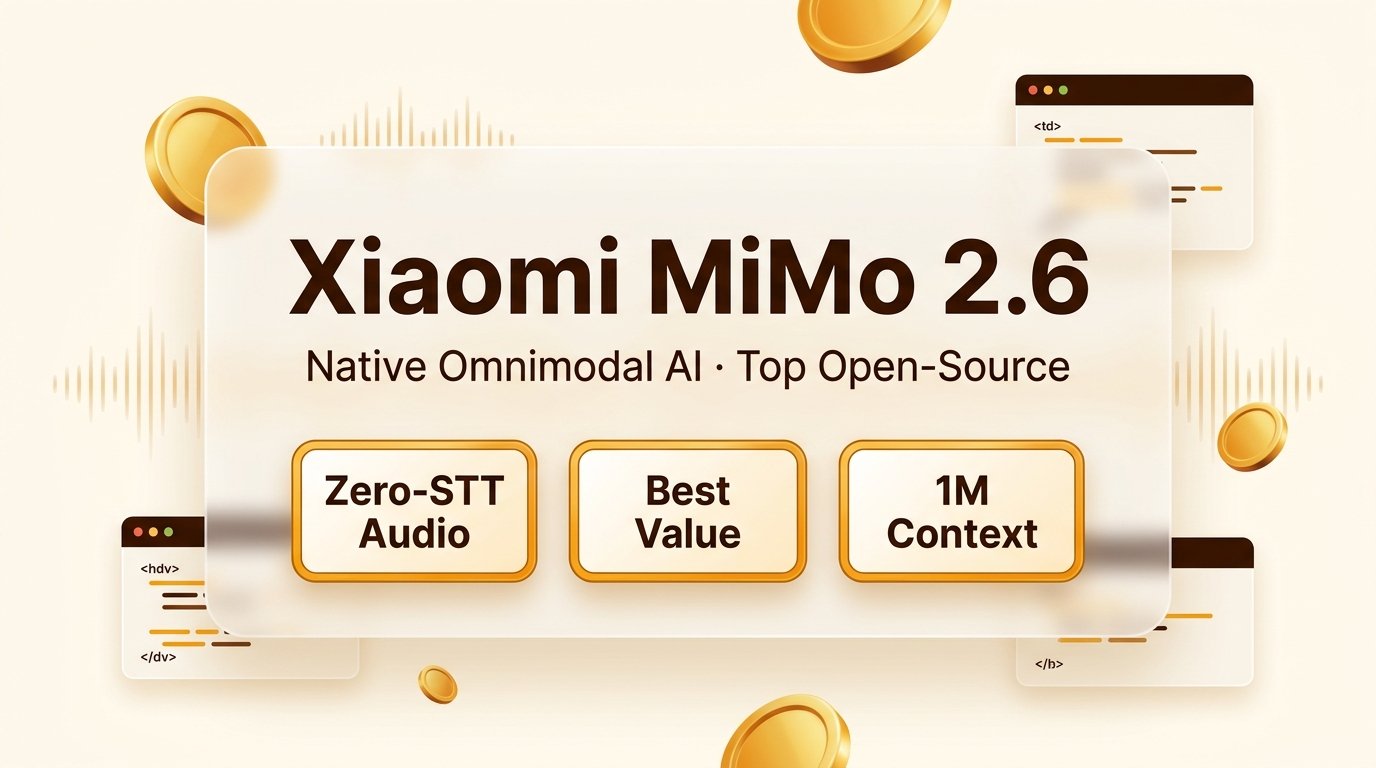
Xiaomi Omnimodal MiMo-V2.6 Pro & Flash Released: Native Audio Without STT and Workhorse Pricing
At a critical juncture where foundation models evolve from text-centric chat to multimodal agents, Xiaomi officially released and open-sourced the next-generation omnimodal model family Xiaomi MiMo-V2.6 on September 22, 2026. The lineup features the flagship MiMo-V2.6-Pro, the high-efficiency MiMo-V2.6-Flash, and MiMo-V2.6-Pro-UltraSpeed, which boosts output throughput by up to 20x.
The MiMo series has long been recognized among full-stack developers and independent engineers as a durable, cost-effective daily driver. In this release, MiMo-V2.6-Pro achieved a score of 46.32 on the Artificial Analysis Intelligence Index v4.3, topping the open-source leaderboard ahead of Kimi K3 and Qwen 3.8 Max while matching Claude Opus 5 and GPT-5.6 Sol across multiple agentic benchmarks. More importantly, it introduces native omnimodal audio input, eliminating the need for an external speech-to-text (STT) pipeline. Xiaomi announced that API pricing remains completely unchanged from V2.5, launching simultaneously on Xiaomi Open Platform, OpenRouter, OpenCode Go, and MiMo Desktop.
💡 Key Highlights
- 🎙️ Native Omnimodal Audio Input: Natively perceives and comprehends raw audio streams without external STT transcription, halving interaction latency while preserving inflection, emotion, emphasis, and ambient acoustic context.
- 💰 Unchanged Workhorse Pricing: Priced lower than DeepSeek v4.1 with free cache writes for a limited time. Flash costs just $0.14 input and $0.28 output per million tokens ($0.0028 on cache hit); Pro costs $0.435 input and $0.87 output ($0.0036 on cache hit).
- 📦 Reliable Daily Driver on OpenCode Go: Outside of heavily restricted platforms, MiMo remains the most generous and reliable quota model for heavy coding workloads.
- 🧠 Frontier Coding and Agent Performance: Top-tier benchmark scores with expanding practical frontiers: pushing beyond Vibe Coding into Vibe World, with 3D Blender asset generation, robotic arm simulation, and verified Lean 4 mathematical proofs.
- 🚀 Simultaneous Multi-Platform Launch: Available day one on Xiaomi Open Platform, OpenRouter, OpenCode Go, AI Studio, and the official 1.0 release of MiMo Desktop, with open model weights and RL code on HuggingFace.
- 🛠️ Drop-in Compatibility: Standard OpenAI-compatible API protocol connects in minutes to Cursor, Claude Code, Codex, Pi, and ZCode.
🔥 1. Native Omnimodal Processing: Bypassing the STT Bottleneck
Most voice-enabled AI applications today rely on a fragmented pipeline: Microphone Audio -> External Whisper/ASR Transcription -> Text to LLM -> TTS Voice Synthesis.
This pipeline suffers from three chronic engineering liabilities:
- Accumulated Latency: Audio chunking, network transfer, and ASR acoustic decoding consume 400 to 800 milliseconds before the LLM generates a single token;
- Acoustic Signal Loss: Collapsing sound into plain text discards intonation, vocal tension, hesitations, emotional cadence, and acoustic background cues;
- Double Billing and Cascading Failures: Running two decoupled API services multiplies endpoint rate limits, outages, and per-minute transcription costs.
MiMo 2.6 embeds audio spectrograms directly into token vectors within a unified multi-head attention network alongside text and vision. Audio is streamed directly through the API, and the model generates responses end-to-end. This eliminates external STT costs and latency, providing human-level situational awareness across customer support, voice-driven coding, and conversational agents.
💰 2. Workhorse Economics: Frontier Intelligence at Unchanged Pricing
For high-throughput developer workloads consuming tens of millions of tokens daily, sustainable economics outweigh synthetic benchmarks. Xiaomi kept commercial API pricing at V2.5 levels. Official pay-as-you-go pricing per million tokens:
- MiMo-V2.6-Flash: $0.14 input, $0.28 output. Context cache hits cost $0.0028, delivering a 98% discount. Batch inference cuts pricing in half to $0.07 input and $0.14 output;
- MiMo-V2.6-Pro: $0.435 input, $0.87 output. Context cache hits cost $0.0036. Batch inference is available at $0.2175 input and $0.435 output;
- MiMo-V2.6-Pro-UltraSpeed: Designed for latency-critical applications with up to 20x throughput, priced at $4.35 input, $8.70 output, and $0.036 on cache hits.
Cache writes are currently free for a limited time, making repository-scale code analysis and heavy system prompt workflows cost-effective. On OpenCode Go, MiMo has consistently provided the most resilient token allocation for sustained coding sessions, giving developers an uninterrupted high-intelligence baseline.
💻 3. Beyond Vibe Coding: From Software to Interactive Worlds
On the DeepSWE v1.1 software engineering benchmark, MiMo-V2.6-Pro scored 71.9, while Flash scored 67.9. On the MiMo Code Bench, Pro recorded 63.2.
While benchmark numbers serve as directional indicators, real-world developer experience will test the model over time. Beyond traditional web and backend code, MiMo 2.6 expands into interactive spatial computing:
- 3D Modeling and World Generation: Coordinates subagents from text or sketches to write Blender Python scripts, generating interactive 3D assets with proper topology and materials;
- Embodied Robotic Simulation: Processes multi-camera vision feeds in real time to close the loop on Franka Panda robotic arm manipulation, object sorting, and precision assembly;
- Formal Mathematical Verification: Assisted researchers in producing over 6,000 lines of rigorous Lean 4 code for the Li-Yorke Chaos Theorem, verified cleanly by the Lean kernel without placeholder proofs.
🛠️ 4. Multi-Platform Setup and Quickstart Examples
Developers can integrate MiMo 2.6 across multiple channels:
1. Xiaomi Open Platform Direct API (Recommended)
Register at https://platform.xiaomimimo.com?ref=Z7EJ2L (referral code Z7EJ2L) for complimentary trial credits and high-throughput quotas. The standard OpenAI-compatible Base URL is https://api.xiaomimimo.com/v1, using model identifiers mimo-v2.6-pro or mimo-v2.6-flash.
Native Omnimodal cURL Example:
curl https://api.xiaomimimo.com/v1/chat/completions \
  -H "Authorization: Bearer $XIAOMI_API_KEY" \
  -H "Content-Type: application/json" \
  -d '{
    "model": "mimo-v2.6-pro",
    "messages": [
      {
        "role": "user",
        "content": [
          {"type": "text", "text": "Analyze this spoken user input for intent and acoustic emotion:"},
          {"type": "input_audio", "input_audio": {"data": "UklGRiQAAABXQVZFZm10IBAAAAABAAEA...", "format": "wav"}}
        ]
      }
    ]
  }'
Python Quickstart:
import os
from openai import OpenAI

client = OpenAI(
    api_key=os.environ.get("XIAOMI_API_KEY"),
    base_url="https://api.xiaomimimo.com/v1",
)

response = client.chat.completions.create(
    model="mimo-v2.6-pro",
    messages=[
        {"role": "system", "content": "You are a staff systems architect."},
        {"role": "user", "content": "Implement an asynchronous LRU memory cache with TTL in TypeScript, complete with test coverage."}
    ],
    temperature=0.3,
)
print(response.choices[0].message.content)
2. Alternative Platforms
- OpenRouter: Access through unified Base URL
https://openrouter.ai/api/v1with model IDsxiaomi/mimo-v2.6-proandxiaomi/mimo-v2.6-flash; - OpenCode Go: Select MiMo 2.6 Pro directly in the model list for high-capacity token allocations;
- MiMo Desktop: Download the official 1.0 desktop release at
https://mimo-ai.xiaomimimo.com/desktop/with integrated 20x UltraSpeed mode.
⚡ 5. IDE and Coding Agent Integration
Thanks to standard OpenAI compatibility, setup takes under two minutes:
- Cursor: Open Settings -> Models -> Add OpenAI Key -> Set Override Base URL to
https://api.xiaomimimo.com/v1-> Add modelmimo-v2.6-pro; - Claude Code: Run
export ANTHROPIC_BASE_URL="https://api.xiaomimimo.com/v1",export ANTHROPIC_API_KEY="$XIAOMI_API_KEY",export CLAUDE_CODE_MODEL="mimo-v2.6-pro", then launchclaude; - Codex CLI: Configure
OPENAI_API_BASE="https://api.xiaomimimo.com/v1",OPENAI_API_KEY="$XIAOMI_API_KEY",CODEX_MODEL_NAME="mimo-v2.6-pro"; - Pi and ZCode: Select OpenAI Compatible provider, configure the Base URL and API key, and select
mimo-v2.6-pro.
⚠️ 6. Developer Best Practices and Caveats
- Anchor Static Prompts to Maximize Cache Hits: With 1M context and 98% cache discounts, place shared system prompts, architecture rules, and dependencies at the very beginning of the prompt sequence;
- Stream Native Audio Directly: Avoid client-side mini-STT models that strip acoustic fidelity. Streaming the raw audio to MiMo produces cleaner semantic and emotional classification;
- Divide Long Agent Sessions: In prolonged debugging sessions with extensive logs, start clean task-specific sessions to maintain peak precision and avoid redundant token charges.
📬 7. Getting Started with Omnimodal AI
From a specialized TTS engine in V2.5 to an omnimodal open-source frontier model in V2.6, Xiaomi MiMo delivers dependable, high-intelligence compute at accessible price points.
Stay updated with FreeAIAPI.org for continuous coverage of verified free tiers, cost-effective endpoints, and open-source models. Subscribe to our Newsletter below for immediate alerts on new releases and pricing updates.
Community Feedback
Comments are tied to your GitHub account — sign in to join the discussion.