
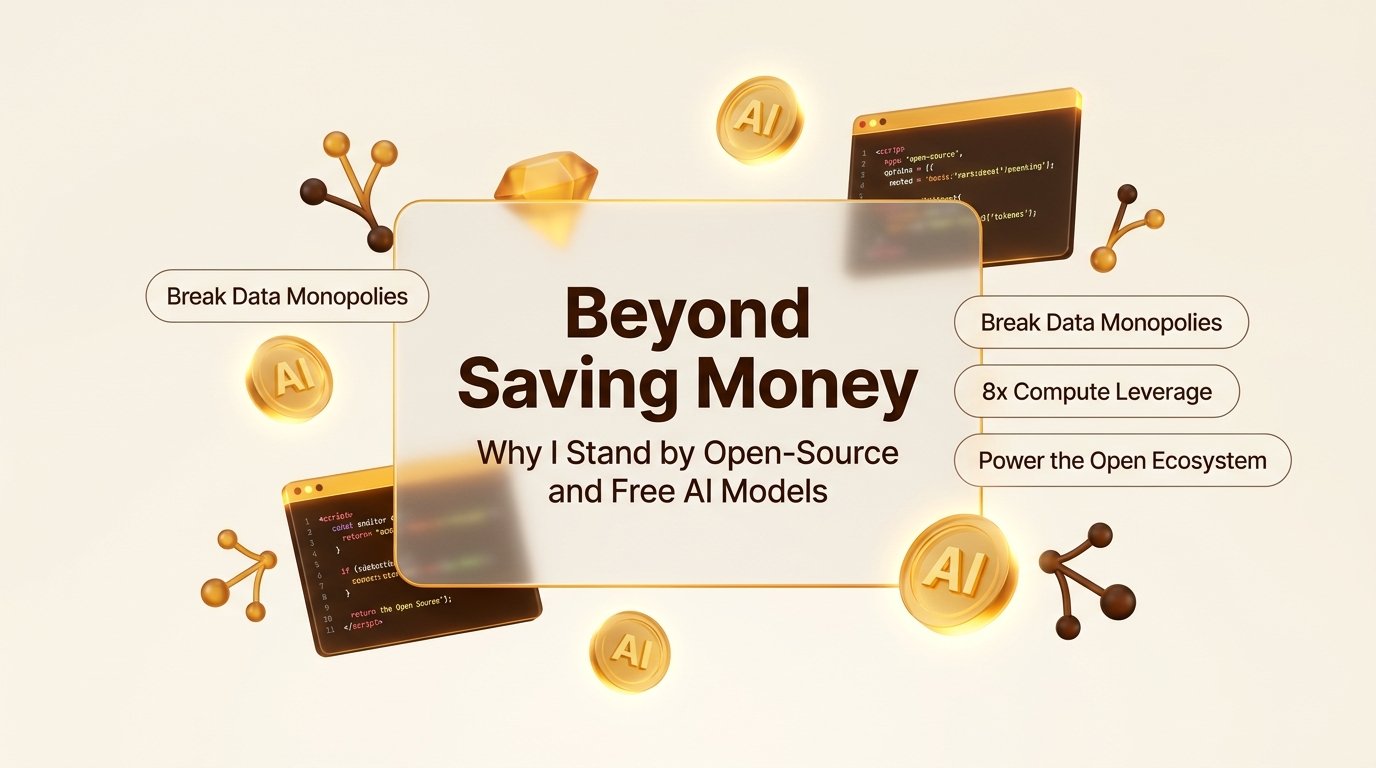
Beyond Saving Money: Why I Stand by Open-Source and Free AI Models
Something interesting happened today.
While testing the Step 5 preview on OpenCode Zen, I ran into an endless stream of 429 rate-limit errors. My coding flow was completely shattered. Frustrated, I took a screenshot of the red error wall and posted on X: "If you ask me, maybe don't launch a free trial if it can't handle the traffic?"
My friend TJ immediately fired back: "If you ask me, maybe don't use free trials then? 😂"
That playful retort made me laugh, but it also pointed straight to a harsh truth: if a free trial means zero reliability, fragile connections, and broken focus, any engineer under delivery pressure will vote with their feet.
Coincidentally, around the exact same time, OpenCode pushed its Operation Cheepseek into Phase 3: under the flat $10/month OpenCode Go plan, the available DeepSeek quota was bumped to $80, and the platform dropped peak vs. off-peak hour restrictions.
Getting an $80 allowance for $10 is an 8x leverage, easily powering hundreds of millions of tokens. While not a 100% free giveaway, this low-cost, steady, and unthrottled compute is a pragmatic solution that actually integrates into day-to-day engineering workflows.
Between that venting session, my friend's teasing, and this pricing update, I wanted to open up and share my deeper thoughts: as the creator of Free AI API, why do I persistently encourage developers to adopt open-source, affordable, and free models?
Cost certainly matters, but my motivation goes far beyond saving a few cups of coffee.
Key Highlights
- The closed-source data flywheel: Claude's sustained edge in coding comes not just from raw model architecture, but from millions of top engineers worldwide feeding it their highest-density prompts, debugging traces, and codebases every single day.
- Voting with tokens: Routing your quality code and prompts to DeepSeek, Qwen, GLM, MiMo, and open-source models is the most tangible way to break the data monopoly and nourish the broader ecosystem.
- The anti-monopoly imperative: If the tech landscape shrinks to just Anthropic or OpenAI, developers will lose all bargaining power, and community-driven initiatives like Free AI API could never survive.
🧠 The Closed-Source Flywheel: What Truly Drives Their Dominance?
Many assume that frontier closed-source models (like Anthropic's Claude lineup) dominate programming purely through superior talent and secret proprietary architectures.
Architectural breakthroughs are real, but when looking under the hood of model iteration, a far more decisive economic dynamic emerges: the positive-reinforcement data flywheel.
The loop is deceptively simple and powerful:
- Early edge: Beginning with Claude 3.5 Sonnet, Anthropic carved out a noticeable lead in code reasoning and instruction precision.
- Talent gravity: That initial advantage convinced the world's most capable engineers, architects, and coding agents (Cursor, Claude Code, etc.) to adopt Claude as their default brain.
- High-density training data: Day in and day out, top engineers feed it elegant system architectures, tricky call stacks, clever algorithms, and robust test suites.
- Self-reinforcing cycle: This unmatched repository of real-world engineering telemetry and alignment feedback fuels the next model generation, widening the performance gap once more.
It is a formidable winner-take-all dynamic.
Yet that is precisely what worries me. As a veteran developer, I do not particularly adore Claude, nor do closed giants necessarily care about individual independent builders.
More critically: I refuse to bind my cognitive workflows and product infrastructure to any single vendor.
Proprietary models carry corporate biases, and corporate roadmaps shift unexpectedly. If every engineer feeds their finest code exclusively to Claude, alternative architectures and open-source models will remain starved of the real-world telemetry they need to mature.
That is why I deliberately distribute my highest-quality inputs across competing models.
🌍 Empowering Open Source is Simple: Vote with Quality Tokens
Contributing to open source often sounds intimidating—submitting massive pull requests to the Linux kernel or donating large sums to foundations.
In the era of generative AI, supporting the open ecosystem is far more direct:
Adopt capable open-source models, explore affordable and free tiers, and cast your vote through your daily engineering workload.
Large language models require high-density interaction to thrive. When you direct DeepSeek to streamline data pipelines, rely on Qwen Coder for type inference, delegate documentation to GLM, or build local automation on Xiaomi MiMo, you accomplish three vital things:
- Weakening closed data gravity: Your calls ensure top-tier code telemetry does not flow exclusively into one corporate black box.
- Providing a real-world crucible: Open models can only patch edge-case flaws when exercised across millions of diverse engineering scenarios.
- Democratizing intelligence: As open models climb the capability ladder, students, solo founders, and engineers in developing regions gain access to premier intelligence without prohibitive monthly fees.
Affordability is vital. For bootstrapped developers, stretching $10 into $80 of compute—or leveraging zero-cost endpoints on Free AI API—enables validating ideas with negligible overhead.
Low cost does not mean inferior, and open source is not a compromise. Every switch you make is a ballot cast for an open, accessible digital ecosystem.
⚠️ The Stakes of Monopoly: What If Only Two Vendors Remain?
Consider a thought experiment: what happens if open models fade away and global AI capability falls under the exclusive control of two or three Silicon Valley giants?
- Total loss of pricing leverage: Without the downward cost pressure of DeepSeek and Qwen, what stops proprietary APIs from skyrocketing? OpenAI once explored a $1,000/month tier. Without competition, paywalls can jump and free access can vanish overnight.
- Algorithmic gatekeeping: Whether your code compiles, whether your app gets approved, and which industries are permitted to automate will be dictated entirely by corporate compliance policies.
- Fragile platform dependency: Denied the ability to self-host or fine-tune weights locally, developers become mere tenants on proprietary servers, vulnerable to being wiped out by a single platform update.
- The end of Free AI API: This platform thrives solely because hundreds of independent providers and open-weight teams compete openly. Without that vibrant landscape, zero-cost access becomes an impossibility.
Competition breeds resilience; open source protects autonomy.
Free AI API was founded on the belief that access to AI must remain equitable and barrier-free. That promise is only viable as long as open-source and competitive alternatives flourish.
🛠️ Practical Daily Staples: Building a Diversified Model Stack
Philosophy must translate into keystrokes. In day-to-day work, avoid placing all your bets on a single provider:
1. OpenCode Go + DeepSeek: The High-Leverage Workhorse
If you need a reliable copilot tightly integrated into your IDE, OpenCode Go's Phase 3 ($10 for $80 of DeepSeek usage, no off-peak restrictions) provides dependable daily horsepower:
- Standard compatibility: Exposes a standard OpenAI-compatible Base URL (
https://opencode.ai/zen/go/v1) that connects smoothly into Cursor, Claude Code, Codex, Pi, and ZCode; - Massive throughput: An $80 budget on DeepSeek's frugal pricing comfortably covers day-in, day-out refactoring and test generation across medium-to-large projects;
- Real stability: Moves beyond fragile free preview tiers into paid-grade uptime and availability.
2. Diverse Daily Drivers: Zhipu GLM & Xiaomi MiMo
- Zhipu GLM & ZCode: One of the earliest foundation model teams, with deep roots in agentic execution and long-context processing. Zhipu is running an official ZCode community event where new accounts unlock welcome token bundles and compute boosts (available via the official invite link:
https://zcode.z.ai/invite/XVJNUH5K). - Xiaomi MiMo: Xiaomi Open Platform's versatile foundation model delivers rapid inference and generous developer allowances (accessible through the exclusive portal:
https://platform.xiaomimimo.com?ref=Z7EJ2L), ideal for text processing and lightweight automations.
3. Engineering Best Practice: Stay Decoupled
In your environment files and tool configs, abstract Base URLs and API Keys into environment variables or lightweight proxies. Dispatch to DeepSeek today, switch to GLM tomorrow, and query MiMo when needed. Retaining provider independence ensures your architecture remains resilient.
📬 Join the Free AI API Community
Creating a healthier tech landscape does not require heroic sacrifices.
Every time you write code or dispatch a prompt, give open models a chance and lend your support to a diversified ecosystem.
To catch timely updates on global open-source releases, zero-cost quotas, and price adjustments, stay tuned to freeaiapi.org and subscribe to our newsletter. Together, let us power a more open, free, and decentralized future for AI.
Community Feedback
Comments are tied to your GitHub account — sign in to join the discussion.