
48-Hour Model Surge: Meta Muse 1.3, Gemini 3.8 Flash & ZCode Nightly Drops — OpenCode Go Remains the Top Pick
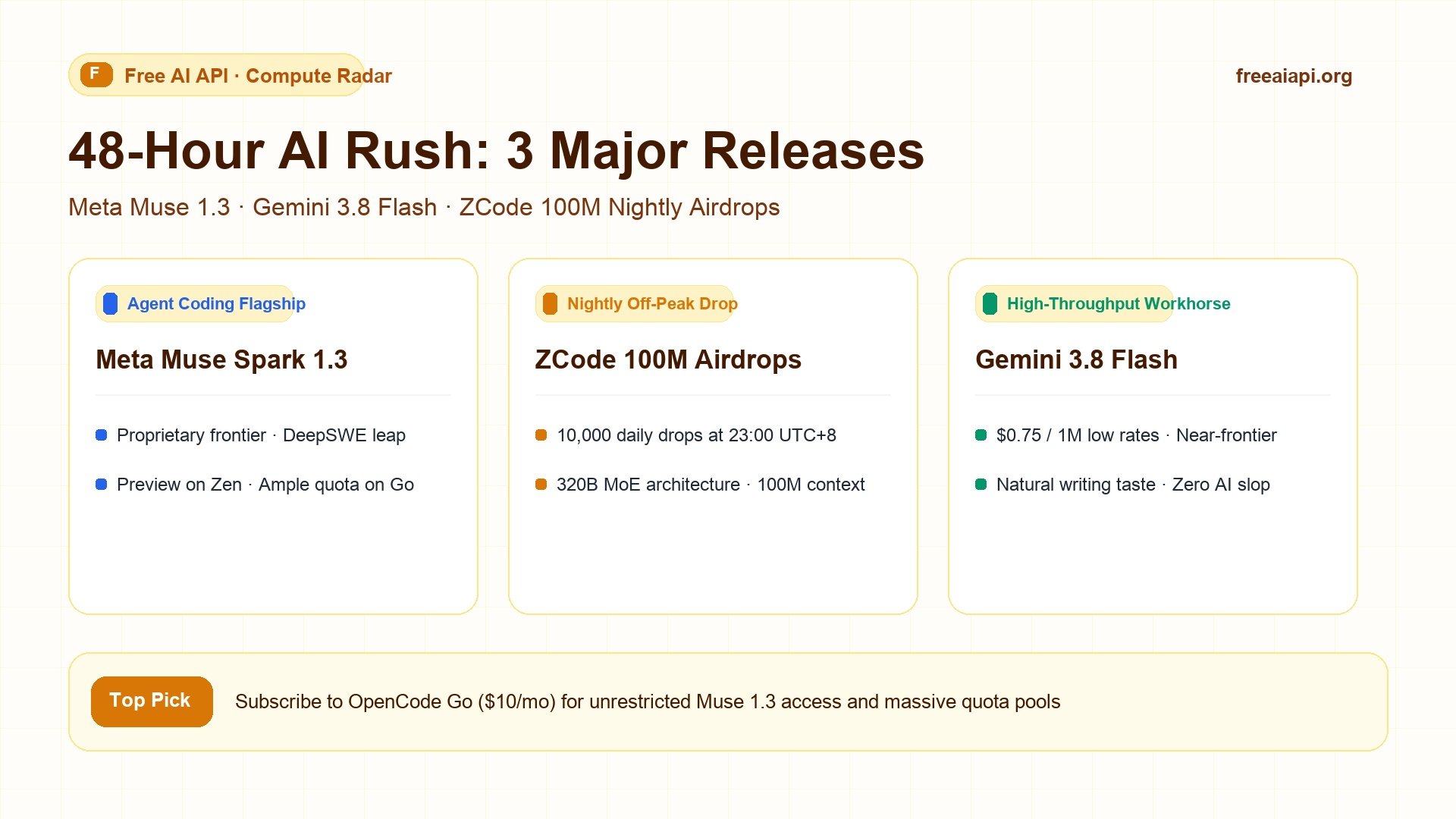
Early September 2026 witnessed a rare, high-density barrage of frontier AI releases. In the 48 hours following Fable 5.1's release, three tech giants and top engineering teams delivered landmark updates: Meta launched its proprietary coding and autonomous agent flagship, Muse Spark 1.3; Zhipu Z.ai rolled out nightly off-peak airdrops distributing 100M GLM-5.3-Flash tokens; and Google dropped its updated high-throughput engineering workhorse, Gemini 3.8 Flash.
Amidst the endless model announcements and marketing fanfare, developers care about two essential questions: What tangible engineering problems do these models solve? And in a landscape plagued by price increases and stealth quotas, what stack delivers the highest-ROI daily compute?
This guide introduces these three high-value models and explains why OpenCode Go at $10/month remains the undisputed top choice.
💡 Key Highlights
- 🎯 Meta Muse Spark 1.3 Surprise Drop: Meta's proprietary flagship coding and agent model delivers outstanding stability on DeepSWE v1.1 and long-horizon refactorings. Available for preview on OpenCode Zen, with very generous quotas on OpenCode Go.
- 🎁 Nightly ZCode 100M Airdrops: Starting two days ago at around 23:00 UTC+8, Z.ai began distributing 10,000 daily free allocations of 100M multimodal GLM-5.3-Flash tokens directly within the ZCode desktop client. First-come, first-served.
- ⚡ Google Launches Gemini 3.8 Flash: Positioned as a software engineering workhorse, it approaches frontier reasoning while maintaining the signature $0.75 / 1M token input pricing. Also readily accessible with standard Gemini Pro subscriptions.
- 🏆 Top Recommendation: Subscribe to OpenCode Go: While $10/month is not zero-cost, it provides massive quota leverage, lets you run Muse 1.3 without balance anxieties, and bundles frontier models like DeepSeek V4 and Grok under a unified gateway.
🔥 1. Three Major Releases: Core Specs & Real Compute Facts
1. Meta Muse Spark 1.3: Heavy Artillery for Agentic Workflows
Following earlier open-weight experiments, Meta released Muse Spark 1.3 as a proprietary, frontier multimodal model specifically tuned for code completions, tool calling, and autonomous multi-step loops. On demanding benchmarks like DeepSWE v1.1, Muse Spark 1.3 demonstrated remarkable stability in cross-module refactoring and bug resolution.
The OpenCode team integrated it immediately:
- Developers can test it via OpenCode Zen;
- The official team connected it directly to OpenCode Go subscriptions, providing ample throughput for intensive agent coding without requiring custom cloud setup.
Webmaster Note: The only constraint is geographic availability, though that is straightforward to navigate. Meta explicitly states user data will be used to train future models—let's be frank, every major AI vendor does this, so don't sweat it and use it freely.
2. ZCode Nightly Airdrops: Claiming 100M Free Tokens at 23:00
While many cloud providers have tightened promotional tiers, Zhipu executed a smart operational move leveraging off-peak datacenter capacity.
Starting nightly around 23:00 UTC+8, the ZCode client (v3.10+) distributes 10,000 free token allocations of 100M multimodal GLM-5.3-Flash tokens:
- Base Architecture: GLM-5.3-Flash features a 320B total, 18B active Mixture-of-Experts design, combining sub-second latency with robust long-context reasoning;
- 100M Context Value: Accommodates hundreds of thousands of lines of source code in a single session, making whole-repository audits and architectural reviews feasible;
- Rules and Constraints: The promotion is free and resets daily, but allocations are first-come, first-served, locked strictly inside the ZCode client, and cannot be exported as an API key. Allocations expire after 10:00 AM the following morning. We recommend downloading the client, logging in, claiming at 23:00 sharp, and lining up heavy tasks to burn through the quota in one session.
Webmaster Note: I have no idea how long this promotion will run. There is no official press announcement, and vendor contacts haven't replied yet, so keep a close eye on it.
3. Google Gemini 3.8 Flash: The High-Throughput Workhorse
Google's Gemini 3.8 Flash focuses squarely on long-horizon software engineering and developer tooling. It bridges the performance gap to trillion-parameter flagship models while holding input costs steady at $0.75 per million tokens ($3.75 for output).
Available across Google AI Studio and Google Antigravity, it serves as an ideal backend for high-concurrency automated tests and large-scale semantic indexing.
🛠️ 2. Why OpenCode Go Remains Our Primary Recommendation
Our goal is to share the most economical and pragmatic ways to use AI productivity tools. After intensive hands-on testing, our strongest operational recommendation is subscribing to OpenCode Go.
1. First, Rule Out the "Big Three" and Chinese Frontier Base Plans
Codex, Claude, and Grok subscriptions at $20–$30/month typically last only 1 to 2 days under heavy agent workflows. Getting through one full project is tight; tackling two is nearly impossible. Chinese commercial base tiers are similarly constrained—my Zhipu Lite weekly trial card burned out in less than a day.
2. The Peace of Mind with Unrestricted Muse 1.3 Access
Meta Muse Spark 1.3 is not the absolute best model—its general knowledge and aesthetic nuances trail the top flagships, feeling closer to DeepSeek V4 Flash. However, it excels in massive volume, low cost, blazing speed, and multimodality, while offering virtually unlimited usage.
OpenCode Go unlocks a massive compute pool for just $10/month:
- Go includes a vast baseline Muse quota;
- With Go active, you can also draw from all free models in Zen, which includes another huge chunk of Muse.
Between Go and Zen, I have yet to exhaust my Muse quota. In this free preview window, OpenCode Go users can code freely without constantly obsessing over balance deductions.
3. Broad Multi-Model Coverage Without Single-Point Failure
Beyond Muse 1.3, OpenCode Go covers top global frontier models including DeepSeek V4, Grok, Kimi, GLM, and Qwen:
- If Muse 1.3 struggles on a complex task, Go gives you immediate access to Grok, Kimi, and Qwen;
- If Muse leaves the free pool, OpenCode has committed to finding sustainable high-value alternatives;
- Native compatibility with terminal TUIs and major IDE agent environments.
4. Official Upstream Service: Transparent, Stable, and Secure
Some people claim: "I know an API relay proxy where you can get tons of Fable 5.1 tokens for dirt cheap!" To that, my only answer is: If you trust shady relay proxies, you're on your own. OpenCode connects directly to official upstreams with guaranteed quality. These models might not be flawless, but they reliably work—no man-in-the-middle attacks, no stealth model swaps. Complete peace of mind.
👉 Official Subscription Channel: Access the OpenCode Go subscription portal through our community referral link to lock in the latest benefits: https://opencode.ai/go?ref=SVE58K5K80
💡 3. Anti-Fragile Developer Stack: Harmonizing Three Compute Streams
Seasoned engineers avoid relying on a single vendor or subscription. Instead, build a resilient multi-tier compute architecture:
Tier 1: Daily Heavy Driver on OpenCode Go
Connect your primary coding IDE or agent to OpenCode Go, designating Meta Muse 1.3 as your primary model. Use it to handle 80% of daily feature implementations, test coverage, and architectural refactoring.
Tier 2: Nightly Whole-Repo Batch Jobs on ZCode
Claim the nightly 23:00 ZCode 100M GLM-5.3-Flash allocation. Assign non-urgent, compute-heavy tasks like legacy code documentation, security audits, and dependency migration reviews to ZCode overnight at zero cost before the 10:00 AM cutoff.
Tier 3: Writing, Content & Search with Gemini 3.8 Flash
In my experience, Gemini produces clean, articulate prose with virtually zero "AI slop", making it my go-to for drafting content and running search-augmented research. And while official API pricing isn't the cheapest, anyone around during last year's promotional waves knows how accessible a Gemini Pro subscription is. It makes an excellent addition to your daily toolkit.
📬 Stay Tuned to Free AI API Radar
From Meta Muse 1.3 to nightly capacity airdrops, AI compute dynamics are shifting toward off-peak efficiency and consolidated subscription leverage. The Free AI API team monitors global developer offerings daily to cut through the marketing noise and highlight genuine value.
Subscribe to our free weekly newsletter to receive zero-cost API updates, price drops, and practical developer strategies directly in your inbox.
Community Feedback
Comments are tied to your GitHub account — sign in to join the discussion.