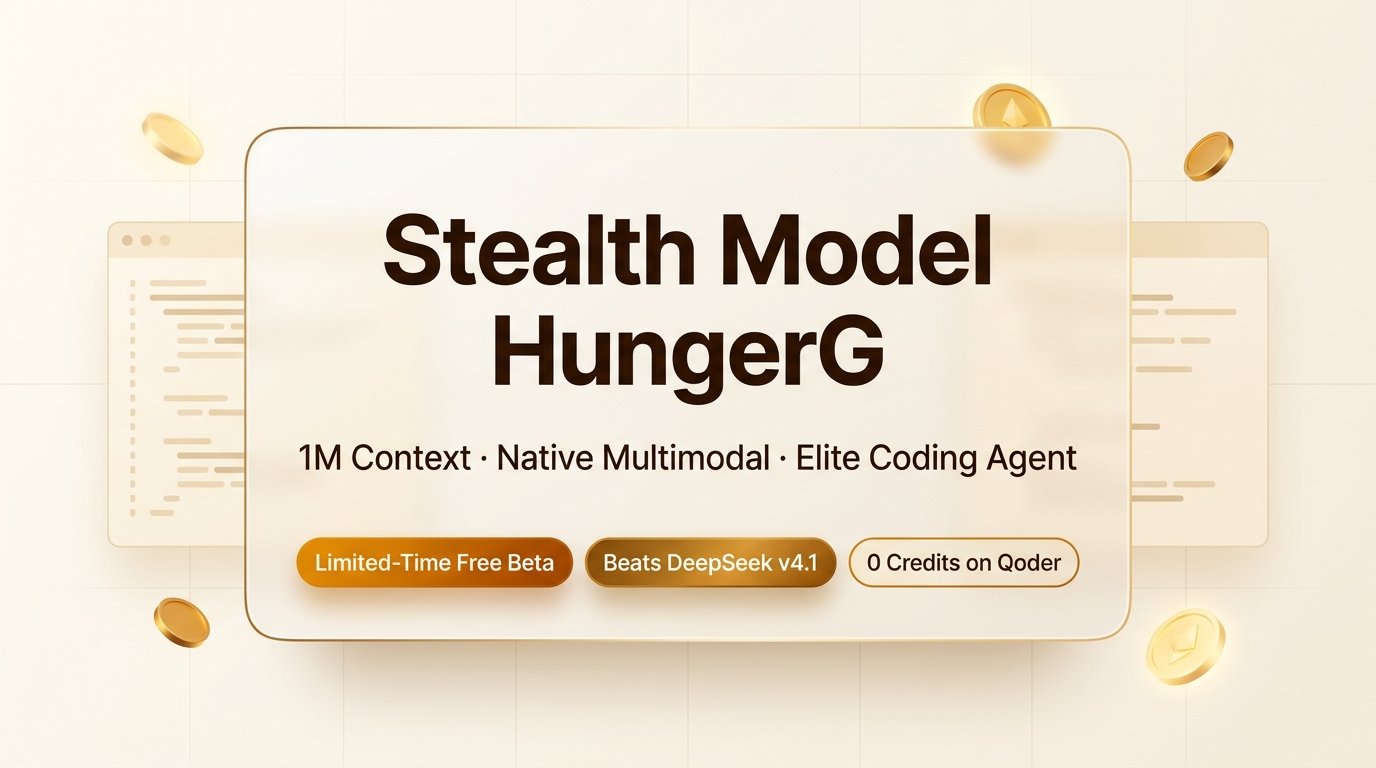
A new mystery challenger has quietly entered the AI arena. In late November 2026, a stealth model code-named HungerG surfaced across developer communities, launching a limited-time free public beta simultaneously on AI coding platforms Qoder and OpenCode Go.
Much like the earlier stealth arrivals of Ox Alpha, HappyHorse, and Qoduck, HungerG has kept its true origin and lab classified. However, with its standard 1 million (1M) token context window, native multimodal understanding, and agentic coding reasoning, it has quickly captured the attention of hackers and developers worldwide. In community hands-on tests, tech influencer Xiaohu tasked it with building a complex Three.js 3D interactive webpage titled "The End of Time." Without any third-party agent skills or prompt plugins, HungerG delivered a functional, playable 3D experience in a single shot, showcasing delivery rates rivaling top proprietary models.
Stealth betas have become the gold standard for top frontier labs validating their next-generation flagships. From Hunter Alpha (later unveiled as Xiaomi MiMo-V2-Pro) and Elephant Alpha (Ant Group's Ling-2.6-flash) to the recent Ox Alpha (GLM-5.3-Flash), AI labs increasingly prefer stress-testing unreleased models under real-world engineering pressure before marketing announcements.
HungerG continues this playbook. Technical telemetry and community probe analyses highlight several standout capabilities:
First, rock-solid 1M context with durable long-range memory. HungerG natively supports 1,000,000 tokens. When analyzing 100,000-line codebases, cross-referencing expansive technical documentation, or maintaining long conversational state, developers report negligible memory drift and virtually no context hallucination.
Second, native multimodal vision and spatial understanding. Beyond textual code, HungerG excels at interpreting interface screenshots, design mocks, and 3D spatial scene logic. In Xiaohu's hands-on test requesting "The End of Time 3D interactive webpage," HungerG seamlessly integrated concepts of particle fields, atmospheric lighting, material shaders, and mouse interaction, spinning up a working Three.js environment in a single pass without extra debugging turns.
Third, autonomous reasoning and agentic tool orchestration. When configured with high-intensity reasoning effort, HungerG exhibits dense, logical deduction paths, remaining resilient across complex dependency chains, asynchronous concurrency, and edge conditions. Rigorous developer comparisons confirm its overall coding quality and task resolution rate clearly surpass DeepSeek v4.1 Flash.
Community speculation currently centers on major labs such as Alibaba Qwen (Qwen 3.5 series), StepFun, DeepSeek, and Zhipu GLM. Yet the team remains anonymous, inviting developers across the globe to stress-test its true limits on production workloads.
Because HungerG is currently in an embedded platform test phase without standalone OpenAI-compatible API keys, developers do not need to configure API keys or environment variables. You can jump right in via two primary clients.
Qoder, the emerging AI coding platform and IDE, provides the most accessible entry point to HungerG. New users signing up through the official activity channel also unlock welcome perks:
OpenCode announced that HungerG is free for all OpenCode Go subscribers this week.
HungerG (stealth model).To make the most of HungerG's free compute window, keep these operational boundaries in mind:
From both product and engineering standpoints, stealth model rollouts offer unique strategic advantages:
First, stripping away brand bias. When benchmarked under an established brand name, community reception is often warped by expectations, fandom, or preconceived skepticism. Under a moniker like HungerG, developers evaluate the model purely on code correctness, first-turn execution success, and bug resolution velocity.
Second, real-world engineering stress testing. Synthetic benchmarks like SWE-bench risk data contamination and overfitting. Throwing a 1M context model directly at production code, real test suites, and esoteric compiler errors exposes tokenizer edge cases, infinite reasoning loops, and concurrency bottlenecks that synthetic benches can never replicate.
For developers who rely on AI in their daily workflow, the winning strategy is maintaining an active "Compute Radar":
Frontier AI advances at breakneck speed, and free flagship compute windows close quickly.
Subscribe to the Free AI API (freeaiapi.org) Newsletter for timely, verified alerts on anonymous stealth drops, vendor promotions, and reliable free API endpoints. We fact-check the fine print so you can harness cutting-edge model intelligence with zero friction.

Community Feedback
Comments are tied to your GitHub account — sign in to join the discussion.