
48-Hour Model Surge: Meta Muse 1.3, Gemini 3.8 Flash & ZCode Airdrops — Why OpenCode Go is Our Top Pick
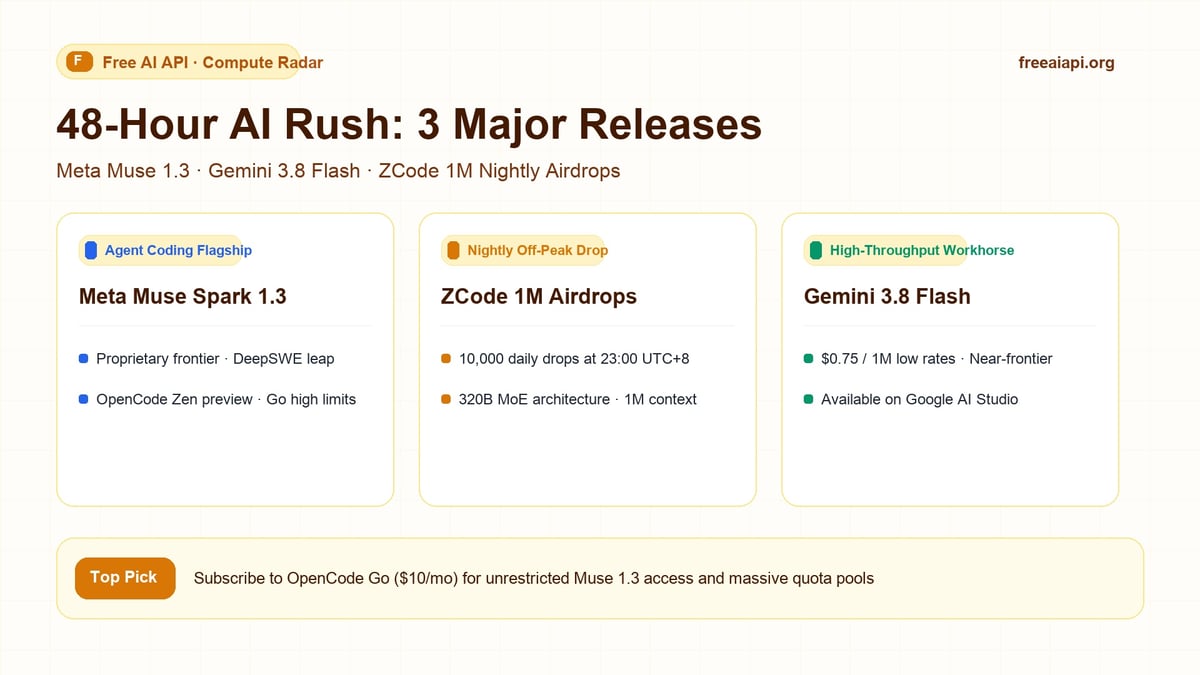
Early September 2026 witnessed a rare, high-density barrage of frontier AI releases. In less than 48 hours, major tech giants delivered landmark updates: Meta surprised the developer world with its proprietary coding and autonomous agent flagship, Muse Spark 1.3; Zhipu Z.ai launched nightly off-peak compute airdrops featuring a 1M-token context GLM-5.3-Flash; and Google released its high-throughput engineering workhorse, Gemini 3.8 Flash.
Amidst the endless product announcements and marketing fanfare, developers only care about two essential questions: What tangible engineering problems do these models solve? And in a landscape plagued by price increases and stealth quotas, what is the smartest compute stack to maximize productivity without breaking the bank?
This guide breaks down the core technical realities, evaluates the compute economics of all three releases, and explains why OpenCode Go at $10/month represents the most compelling daily driver for running Muse 1.3.
💡 Key Highlights
- 🎯 Meta Muse Spark 1.3 Surprise Drop: Meta's proprietary flagship coding and agent model delivers exceptional stability on DeepSWE v1.1 and long-horizon refactorings. Available for preview on OpenCode Zen and included for broad unrestricted use within OpenCode Go.
- 🎁 Nightly ZCode 1M Airdrops: Starting two days ago at around 23:00 UTC+8, Z.ai began distributing 10,000 daily free allocations of GLM-5.3-Flash featuring a native 1M context window directly within the ZCode desktop client.
- ⚡ Google Launches Gemini 3.8 Flash: Engineered as an accessible software engineering workhorse, it approaches frontier reasoning while preserving the signature $0.75 / 1M token input pricing.
- 🏆 Top Recommendation: Subscribe to OpenCode Go: While $10/month is not zero-cost, it provides massive quota leverage, lets you run Muse 1.3 without balance anxieties, and bundles frontier models like DeepSeek V4 and Grok under a unified gateway.
🔥 1. Dissecting the 48-Hour Surge: Core Specs & Compute Facts
1. Meta Muse Spark 1.3: Heavy Artillery for Agentic Workflows
Following earlier open-weight experiments, Meta unveiled Muse Spark 1.3 as a proprietary, frontier multimodal model specifically tuned for multi-file codebase reasoning, precise tool calling, and autonomous multi-step loops. On demanding benchmarks such as DeepSWE v1.1, Muse Spark 1.3 demonstrated remarkable consistency in cross-module refactoring and bug resolution.
Developer access evolved rapidly:
- Developers can experiment with ad-hoc requests via OpenCode Zen at pay-as-you-go rates;
- More importantly, OpenCode directly incorporated Muse Spark 1.3 into its OpenCode Go subscription pool, granting substantial throughput without requiring bespoke cloud infra or API key negotiations.
2. ZCode Nightly Airdrops: Claiming 1M Free Tokens at 23:00
While many cloud providers have dialed back promotional tiers, Zhipu executed a smart operational maneuver leveraging off-peak datacenter capacity.
Starting nightly around 23:00 UTC+8, the ZCode client (v3.10+) distributes 10,000 free token allotments for GLM-5.3-Flash:
- Base Architecture: GLM-5.3-Flash features a 320B total, 18B active Mixture-of-Experts design, combining sub-second latency with robust long-context reasoning;
- 1M Context Window: Accommodates hundreds of thousands of lines of source code in a single prompt, making whole-repository audits and architectural reviews feasible;
- Rules and Constraints: The promotion is genuinely free and resets daily, but quotas are first-come-first-served and locked strictly inside the ZCode client. It cannot be exported as an external API key. We recommend keeping the client installed and logged in to claim before allocations deplete.
3. Google Gemini 3.8 Flash: The High-Throughput Workhorse
Google's Gemini 3.8 Flash focuses squarely on long-horizon software engineering and developer tooling. It bridges the performance gap to trillion-parameter flagship models while holding input costs steady at $0.75 per million tokens ($3.75 for output).
Available across Google AI Studio and Google Antigravity, it serves as an ideal backend for high-concurrency automated tests and large-scale semantic indexing.
🛠️ 2. Why OpenCode Go Remains Our Primary Recommendation
In today's AI coding market, developers often oscillate between two extremes: endlessly hunting fragile zero-dollar endpoints, or paying multiple $20/month subscriptions across isolated services.
After extensive benchmarking, our strongest operational recommendation is subscribing to OpenCode Go.
1. The Peace of Mind with Unrestricted Muse 1.3 Access
Meta Muse Spark 1.3 is computationally intensive. When billed through standard pay-per-token API tiers, running complex multi-turn agent workflows across heavy contexts can quickly rack up substantial charges.
OpenCode Go addresses this pain point: for a flat $10/month, users tap into an expansive compute pool. By including Muse 1.3 in its core high-limit tier, engineers can code freely without constantly scrutinizing balance deductions.
2. Broad Multi-Model Coverage Without Vendor Lock-In
Beyond Muse 1.3, OpenCode Go offers generous access to models such as DeepSeek V4 and Grok:
- Unified gateway access eliminates the friction of managing international credit cards across separate platforms;
- Strong leverage ratio means a $10 commitment easily supports an active software engineer through an entire month of demanding development;
- Seamless integration with both terminal TUIs and major IDE agent environments.
👉 Official Subscription Channel: Access the OpenCode Go subscription portal through our community referral link to lock in the latest benefits: https://opencode.ai/go?ref=SVE58K5K80
💡 3. Anti-Fragile Developer Stack: Harmonizing Three Compute Streams
Seasoned engineers avoid relying on a single vendor or subscription. Instead, build a resilient multi-tier compute architecture:
Tier 1: Daily Heavy Driver on OpenCode Go
Connect your primary coding IDE or agent to OpenCode Go, designating Meta Muse 1.3 as your primary model. Use it to handle 80% of daily feature implementations, test coverage, and architectural refactoring.
Tier 2: Nightly Whole-Repo Batch Jobs on ZCode
Leverage the nightly 23:00 ZCode drops to capture 1M context allocations. Assign compute-heavy, non-urgent tasks like legacy code documentation, security audits, and dependency migration reviews to ZCode overnight at zero cost.
Tier 3: High-Concurrency Retrieval with Gemini 3.8 Flash
Whenever a pipeline requires firing dozens of parallel searches, multi-file lint verifications, or extensive log pattern extraction, route requests to Gemini 3.8 Flash for ultra-low latency at wholesale costs.
⚠️ Critical Rule: Never Switch Models Mid-Session
Modern frontier models rely heavily on prompt caching to deliver high speed and reduced token rates. If you switch models halfway through an active coding thread, previous prompt caches become completely invalid, forcing the new model to ingest the full conversation history at standard full-price rates. Lock your model choice for the duration of a specific task.
📬 Stay Tuned to Free AI API Radar
From Meta Muse 1.3 to nightly capacity airdrops, AI compute dynamics are shifting toward off-peak efficiency and consolidated subscription leverage. The Free AI API team monitors global developer offerings daily to cut through the marketing noise and highlight genuine value.
Subscribe to our free weekly newsletter to receive zero-cost API updates, price drops, and practical developer strategies directly in your inbox.
Community Feedback
Comments are tied to your GitHub account — sign in to join the discussion.