
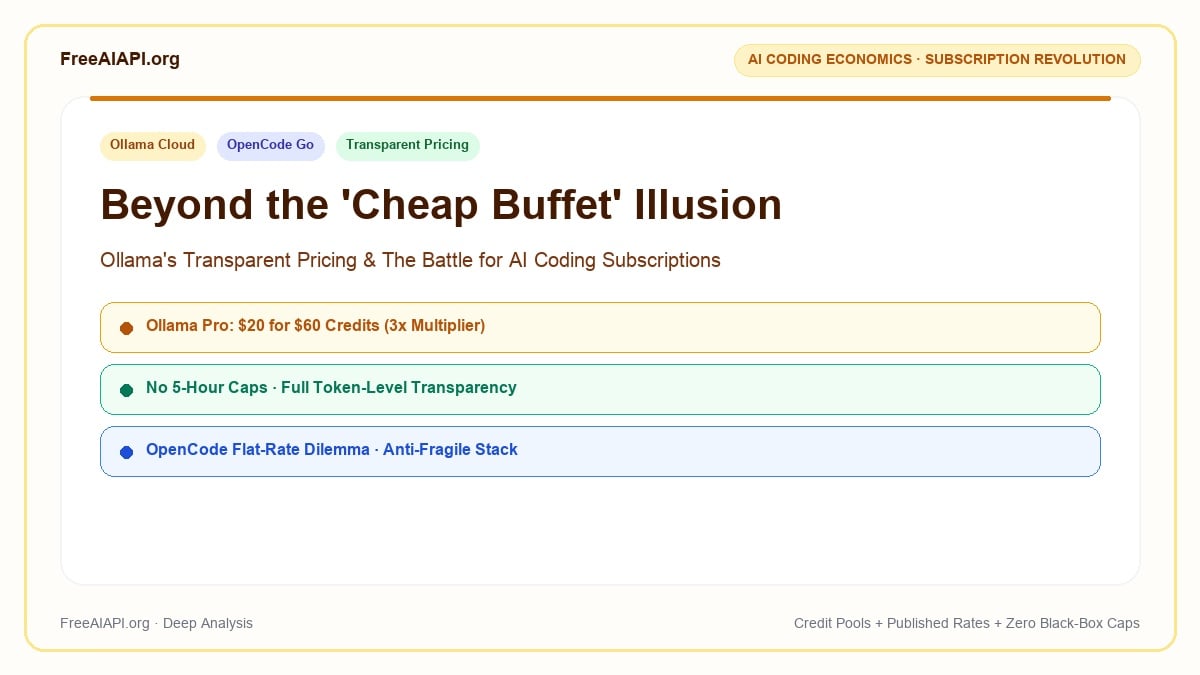
Beyond the "Cheap Buffet" Illusion: Ollama's Transparent Pricing and the Battle for AI Coding Subscriptions
As large language models transition into deeper engineering workflows, AI coding tools are undergoing a dramatic shakeup in product paradigms and monetization strategies. In late August 2026, open-weight runtime pioneer Ollama restructured its cloud pricing model, officially unveiling an industry-standard mechanism dubbed "Transparent Pricing."
The announcement triggered lively debate across developer communities. On one hand, Ollama eliminated opaque GPU-time billing, abolishing strict 5-hour and weekly session cutoffs in favor of published per-token pricing bundled with up to a 3x credit allowance. On the other hand, the shift immediately drew comparisons to OpenCode, which has recently faced community friction over shifting subscription caps and price adjustments.
What is happening beneath the surface of low-cost monthly plans? Why do flat-rate AI coding subscriptions frequently struggle with sustainability? Can Ollama's transparent token ledger finally bridge the gap between heavy compute costs and developer experience? This analysis dissects the economics behind AI coding power and outlines an anti-fragile compute strategy for modern developers.
💡 Key Highlights
- 🎯 Ollama Introduces Transparent Pricing: Pro plan ($20/mo) includes $60 in usage credits, Max plan ($100/mo) includes $300, and Team plan provides $1,000 in shared credits, delivering a clear 3x compute multiplier.
- 🚫 Eliminating Black-Box Limits: Abolishes unpredictable GPU-time billing and 5-hour/weekly caps. When monthly credits are exhausted, service seamlessly continues at published per-token rates without throttling or disruption.
- 🔍 Understanding OpenCode's Growing Pains: Transitioning from request counts to a $60 credit pool, adding $15 sub-caps on flagship models, and phasing out early promotions stem directly from exponential agent context growth and heavy-user compute drain. Flat-rate pricing faces relentless margin pressures.
- ⚖️ A Paradigm Shift: AI coding subscriptions are moving away from the illusion of "all-you-can-eat buffets" toward transparent ledgers, credit multipliers, and graceful pay-as-you-go fallbacks.
- 🛠️ Anti-Fragile Workflow: Leverage free flagship endpoints like AMD Radeon Cloud for day-to-day coding, reserving high-leverage plans like Ollama or OpenCode for deep architectural refactoring and multi-agent loops.
🔥 1. Dissecting Ollama's Shift: What is True "Transparent Pricing"?
For an extended period, Ollama Cloud operated on a model that perplexed many engineers: billing by GPU compute duration paired with rigid 5-hour and weekly usage ceilings.
In the era of small models, this mechanism remained tolerable. However, as frontier open-weight models expanded into trillion-parameter territories, such as Kimi K3 and DeepSeek V4, single inference and thinking durations became unpredictable. Developers could rarely estimate GPU duration for complex tasks, often crashing into hidden throttling walls mid-refactor.
Ollama's new pricing restructures the rules around verifiable industry benchmarks:
1. 3x Compute Leverage and Clear Plan Tiers
Rather than marketing vague "unlimited" promises, Ollama converts monthly subscription fees directly into token spending pools:
- Pro ($20/month): Includes $60 in monthly credits, effectively delivering 3x compute purchasing power at published wholesale rates with 3 concurrent slots;
- Max ($100/month): Includes $300 in monthly credits with 10 concurrent slots and early access to newly published architectures;
- Team ($500/month): Includes $1,000 in shared monthly credits with unlimited seats, unified billing, and centralized administration;
- Free ($0/month): Provides starter credits for lightweight baseline models, supporting zero-service-fee pay-as-you-go expansions.
2. Zero Cliff-Hangers with Graceful Pay-As-You-Go Fallbacks
Few experiences are as disruptive as having an active coding session halted by a sudden "quota exhausted" modal during an urgent late-night bug fix.
Under Ollama's updated system, exhausting included monthly credits triggers neither throttling nor service termination. Requests transition automatically to published per-token rates. Furthermore, the dashboard itemizes exact prompt, cached prompt, and completion token metrics alongside precise dollar costs for every invocation.
3. Strict Enterprise Privacy and Broad Compatibility
Addressing privacy requirements, Ollama Cloud enforces a zero-data-retention policy: prompts are never logged, completion outputs are not stored, and user code is never utilized for model training. Infrastructure is hosted across the US and Europe, with Singapore routing available for select Qwen models. Crucially, the endpoint natively integrates with Claude Code, Codex, Aider, and custom agent toolchains.
⚖️ 2. Understanding OpenCode: Why Flat-Rate Coding Plans are an Extreme Gamble
Following Ollama's announcement, industry comparisons with OpenCode were inevitable. OpenCode Go has undergone several adjustments recently, sparking community debate.
However, examining platform economics reveals that OpenCode's shifts are not arbitrary. Operating low-cost subscriptions for active developers remains one of the most punishing business models in software today.
1. Coding Agents as Token Grinders
Standard chat interactions rarely consume more than a few thousand tokens. Modern coding agents operate on vastly different scales:
- Repository indexing and context hydration routinely pump tens of thousands of lines into the context window;
- Tool calling, unit testing loops, and automated code editing trigger iterative inference loops where a single refactor can easily generate millions of tokens;
- Even with prompt caching enabled, cache misses and large-state rehydration incur substantial raw compute overhead.
2. The "Buffet Paradox" and Extreme Power Users
Buffet restaurants stay profitable because moderate diners offset heavy eaters. In developer tools, that mathematical equilibrium quickly disintegrates.
During OpenCode Go's early $10/month era, light users consumed negligible resources, while the top 5% of power users—automating full CI/CD loops and persistent background agents—easily generated hundreds of dollars in foundational compute bills. Faced with unsustainable burn, platforms must either shut down or revise their terms.
3. OpenCode's Defensive Evolution
Reviewing OpenCode Go's history illustrates an ongoing quest for financial equilibrium:
- Early request-count caps failed because token density per request varied by orders of magnitude;
- The subsequent dollar-credit model ($10 for $60 credit) provided an aggressive 6x leverage ratio;
- As flagship models like Grok 4.5 and GPT-5.6 Luna proved costly, model-specific sub-caps ($15 each) were introduced alongside the removal of introductory promotions.
While rule shifts understandably test user patience, they mirror the harsh realities facing software teams navigating volatile GPU markets without proprietary data centers.
📊 3. Ollama Cloud vs. OpenCode Go: Comparative Matrix
The following table contrasts the operational and economic profiles of both platforms:
| Dimension | Ollama Cloud (Transparent Model) | OpenCode Go (Current Tier Rules) |
|---|---|---|
| Monthly Entry Point | $20 / month (Pro) | $10 / month |
| Included Allowance | $60 credit injection (3x multiplier) | $60 credit value (6x multiplier) |
| Model-Specific Caps | None; all models draw from shared pool | Specific flagship models capped at $15 |
| Exhaustion Behavior | Seamless pay-as-you-go at published rates | Requires monthly reset or BYOK switch |
| Billing Transparency | Itemized token and cent ledger per call | Aggregated credit balance display |
| Concurrency | Pro: 3 slots; Max/Team: 10 slots | Single workspace binding |
| Data Privacy | Strict zero data retention policy | Governed by upstream provider terms |
| Ideal Profile | Engineers demanding zero disruption and clear audits | Budget-sensitive coders wanting maximum multiplier |
Key takeaways:
- Developers seeking maximum raw leverage for moderate interactive coding still find exceptional value in OpenCode Go;
- Engineers running continuous agent loops, multi-file refactors, and mission-critical workflows gain peace of mind from Ollama's predictable token accounting and uninterrupted overages.
🛠️ 4. Quickstart Guide: Connecting IDEs and Coding Agents
Integrating cloud endpoints into modern development environments is straightforward. Here is how to configure and verify Ollama Cloud via terminal and code.
1. Environment Configuration
Generate your API key from the Ollama dashboard and export the target credentials:
export OLLAMA_API_KEY="your-ollama-api-key"
export OLLAMA_BASE_URL="https://ollama.com/v1"
2. cURL Verification
Issue a standard OpenAI-compatible request to evaluate DeepSeek V4 or Kimi:
curl https://ollama.com/v1/chat/completions \
  -H "Authorization: Bearer $OLLAMA_API_KEY" \
  -H "Content-Type: application/json" \
  -d '{
    "model": "deepseek-v4-flash",
    "messages": [
      {"role": "user", "content": "Write a TypeScript LRU cache class with TTL support."}
    ]
  }'
3. Python SDK Usage with Cost Tracking
Inspect token metrics directly through the OpenAI SDK:
import os
from openai import OpenAI

client = OpenAI(
    base_url="https://ollama.com/v1",
    api_key=os.environ.get("OLLAMA_API_KEY"),
)

response = client.chat.completions.create(
    model="deepseek-v4-flash",
    messages=[
        {"role": "user", "content": "Analyze trade-offs in micro-frontend architectures."}
    ],
)

print(response.choices[0].message.content)

usage = response.usage
print("
=== Token Consumption Breakdown ===")
print(f"Prompt Tokens: {usage.prompt_tokens}")
print(f"Completion Tokens: {usage.completion_tokens}")
print(f"Total Tokens: {usage.total_tokens}")
4. Terminal Agents: Claude Code & Aider
To launch command-line agent tools against Ollama endpoints:
# Launch Aider with Ollama Cloud
aider --openai-api-base https://ollama.com/v1 --openai-api-key $OLLAMA_API_KEY --model deepseek-v4-flash
💡 5. Building an Anti-Fragile Compute Strategy
The core lesson from recent pricing adjustments is straightforward: never tether your entire workflow to a single provider or subscription tier.
Relying entirely on flat-rate buffets leaves teams vulnerable to sudden rule modifications or throttling. An optimal setup adopts a layered, resilient architecture:
Layer 1: Zero-Cost Public APIs for 70% of Daily Tasks
Routine unit tests, syntax checks, and small functions do not require premium paid tokens.
- AMD's Radeon Cloud Token Factory provides DeepSeek-V4-Flash with 1M context free of charge without credit cards;
- Pair with free tiers from Zhipu GLM or NVIDIA NIM to absorb baseline volume.
Layer 2: High-Leverage Monthly Plans for Deep Refactoring
When executing multi-file architecture overhauls or orchestrating multi-agent loops:
- Rely on Ollama Pro's transparent credits or OpenCode Go;
- Explore OpenCode's subscription plans via our referral link: https://opencode.ai/go?ref=SVE58K5K80;
- With daily tasks offloaded to free tiers, your subsidized allowances will stretch across months of deep work.
This layered approach guarantees continuous uptime, shields your budget from policy fluctuations, and maximizes productivity.
📬 Subscribe to the Free AI API Radar
The AI infrastructure landscape moves at breakneck speed. The Free AI API team continuously monitors zero-cost endpoints, developer promotions, and billing shifts across global providers.
Subscribe to our free weekly newsletter to receive verified API keys, pricing alerts, and deep technical analyses straight to your inbox!
Community Feedback
Comments are tied to your GitHub account — sign in to join the discussion.