
1. Breakthrough Architecture: MSA (MiniMax Sparse Attention)
Traditional Transformer models face quadratic (O(N^2)) computation and memory complexity scaling as context length increases. To solve this bottleneck, MiniMax introduced its proprietary MiniMax Sparse Attention (MSA) architecture.
- How it works: Unlike traditional Full Attention, MSA performs block-level selection over uncompressed Key-Value (KV) cache pairs, enabling precise retrieval and attention allocation.
- Compute Efficiency: This innovative sparse attention approach drastically accelerates prefill and decoding phases. When processing a 1M-token context window, the per-token compute cost is reduced to roughly 1/20th of traditional full attention models.
2. Technical Specifications & Frontier Performance
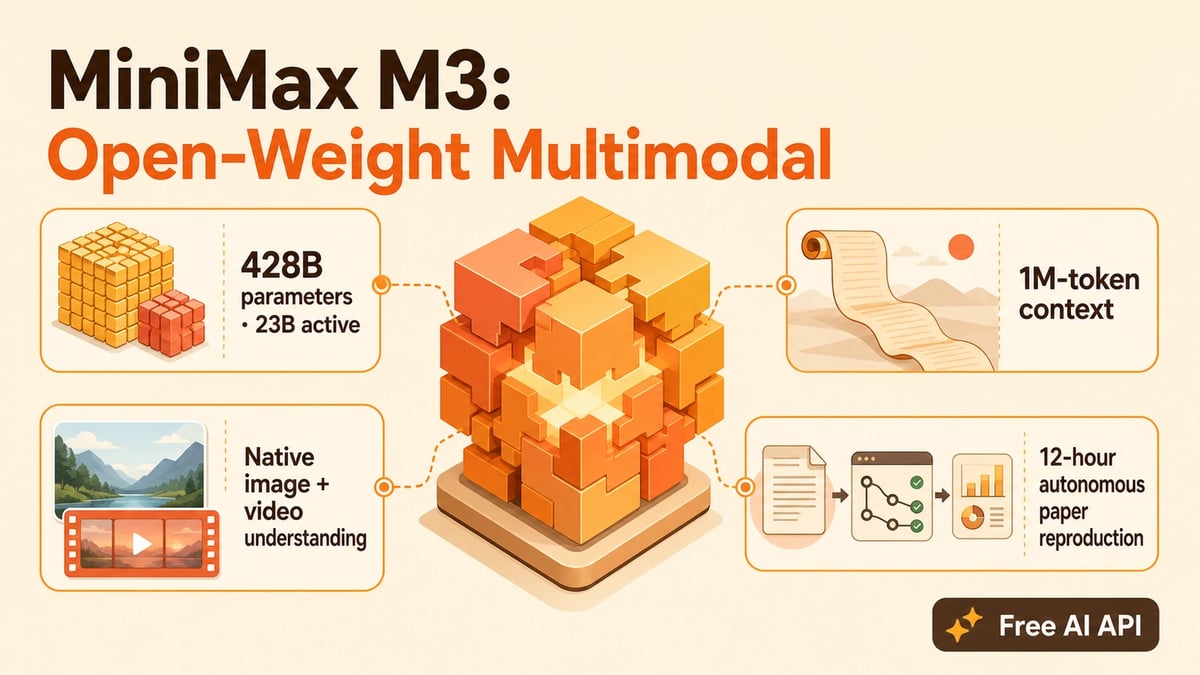
MiniMax M3 is positioned as a next-generation open-weight natively multimodal foundation model. Here are its standout technical specifications:
- 1 Million Token Context Window: Easily handles entire books, hours of audio/video, or massive software repositories with a guaranteed 512K perfect recall.
- Native Multimodality & Computer Use: M3 is trained on interleaved multimodal data from "step zero" (rather than relying on post-training adapters). It supports text, high-resolution image, and video inputs. Furthermore, it possesses "Computer Use" agentic capabilities, enabling it to navigate and operate desktop operating systems autonomously.
- Frontier Benchmarks:
- Coding (SWE-Bench Pro): Outperforms GPT-5.5 and Gemini 3.1 Pro, ranking as one of the top autonomous coding agent models.
- SVG Rendering (SVG-Bench): Surpasses Claude Opus 4.7, showing precise control in vector graphic generation and rendering.
- Document Parsing (OmniDocBench): Leads Gemini 3.1 Pro in visual/layout understanding of complex documents with rich formats, charts, and mathematical equations.
3. OpenCode Terminal AI Agent Offers Free M3 Access
Alongside the launch of MiniMax M3, the popular open-source Terminal TUI coding agent OpenCode posted a major announcement on X (formerly Twitter):
"MiniMax M3 will be launching soon. You can try it right now in OpenCode. For free."—— Source: OpenCode Official X Status
This means developers can experience this state-of-the-art 1M-token multimodal model immediately via the OpenCode client for free—no personal API Key required!
What is OpenCode?
OpenCode is a terminal-first, open-source AI coding assistant designed for deep integration into developer workflows. Key features include:
- TUI Interface: Interactive terminal interface with support for quick
/commands. - Local File & Command Execution: Reads local files and executes tests or compilation within a sandbox or upon user approval.
- Provider Agnostic: Easily connects to various AI endpoints, now featuring direct free trial access to MiniMax M3.
4. Quick Start Guide for Developers
1. Install OpenCode
For macOS/Linux, install via curl:
curl -fsSL https://opencode.ai/install | bashOr via Homebrew:
brew install opencode-ai/tap/opencodeFor Windows, install globally via npm:
npm i -g opencode-ai@latest2. Run OpenCode with MiniMax M3
Start the TUI inside your project directory:
opencodeOnce inside:
- Type
/modelsto select MiniMax M3 from the model list. - Use
@planor@buildto invoke autonomous coding agents for codebase-wide refactoring, leveraging its 1M-token context.
3. (Optional) Access via Official API
For application developers, MiniMax M3 is accessible via OpenAI-compatible endpoints:
cURL Example:
curl https://api.minimax.io/v1/chat/completions \
  -H "Content-Type: application/json" \
  -H "Authorization: Bearer $MINIMAX_API_KEY" \
  -d '{
    "model": "minimax-m3",
    "messages": [
      {"role": "user", "content": "Write a concurrent web scraper in Python."}
    ],
    "max_tokens": 1024
  }'
Python Example:
from openai import OpenAI

client = OpenAI(
    api_key="your-minimax-api-key",
    base_url="https://api.minimax.io/v1"
)

response = client.chat.completions.create(
    model="minimax-m3",
    messages=[
        {"role": "user", "content": "Analyze the performance differences between MSA and traditional Transformer attention."}
    ]
)

print(response.choices[0].message.content)
Conclusion
MiniMax M3's release signals the acceleration of low-cost, ultra-long-context agentic intelligence. Thanks to the revolutionary computational efficiency of the MSA architecture, 1M-context models are no longer the exclusive privilege of tech giants. By bridging these capabilities with open-source developer communities like OpenCode, programmers are gaining zero-cost access to state-of-the-art AI, propelling terminal-first development automation forward.
Community Feedback
Comments are tied to your GitHub account — sign in to join the discussion.