
GPT-5.6 arrived with three tiers—Sol, Terra, and Luna—but the official API is not a conventional free tier. The useful question is not simply whether GPT-5.6 is free. It is which route gives you enough verified free usage to build or test something real.
For a broader look at the models, pricing, and launch context, read the MuiRouter GPT-5.6 overview. This guide stays focused on free access and its restrictions.
Last verified on July 12, 2026. Quotas and eligibility can change, so check the linked official pages before relying on them in production.
The short answer
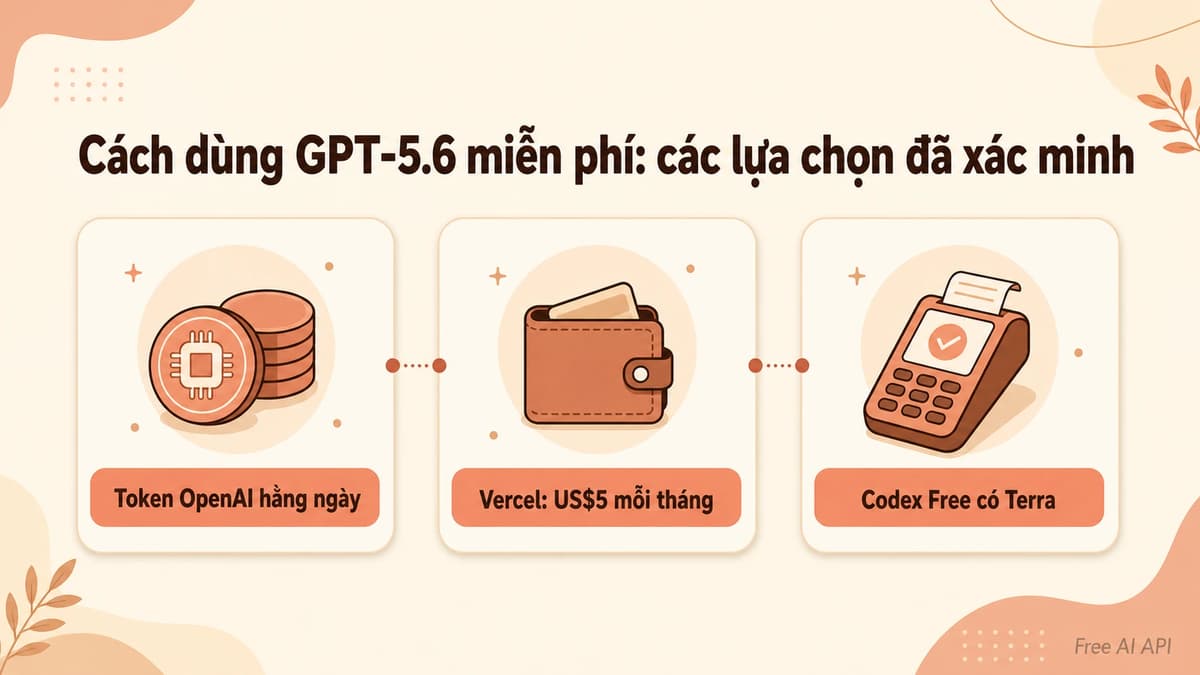
- Best recurring API allowance: OpenAI data sharing. Eligible API organizations can receive hundreds of thousands or millions of complimentary tokens every day, but must share API inputs and outputs with OpenAI.
- Easiest API trial: Vercel AI Gateway. A free team receives $5 in monthly Gateway credits and can spend them on any available model, including GPT-5.6.
- Best free coding access: Codex Free. Free ChatGPT accounts can use GPT-5.6 Terra inside Codex, with a small workload-dependent allowance.
Standard ChatGPT Free conversations do not currently include GPT-5.6. GitHub Models also does not list a directly selectable GPT-5.6 model at the time of publication, so neither is counted as a reliable route here.
1. OpenAI API: the largest free allowance, with a data trade-off
OpenAI offers complimentary daily tokens to some API organizations that opt in to share prompts and completions. This is the most generous verified route if you need actual API access.
For GPT-5.6, the daily shared quotas are:
- GPT-5.6 Sol: 250,000 tokens for usage tiers 1–2, or 1 million tokens for tiers 3–5.
- GPT-5.6 Terra and Luna: 2.5 million tokens for tiers 1–2, or 10 million tokens for tiers 3–5.
There are several important conditions:
- The offer is not available to every organization. Your Data Controls page must explicitly say that you are eligible for free daily usage.
- An organization owner must enable sharing for all projects or selected projects.
- Your API account still needs a positive balance before requests can run.
- Only traffic from projects with sharing enabled qualifies.
- Fine-tuning, evals, tool use, and fine-tuned models are excluded.
- The quota resets at 00:00 UTC. If one request pushes your daily total over the limit, that entire request is billed normally.
This is not free usage without a cost: you are explicitly allowing OpenAI to receive the inputs and outputs of qualifying requests. Do not enable it for projects carrying private source code, customer data, confidential documents, or other material you are not allowed to share.
To check eligibility, open your OpenAI Platform organization settings, find Data Controls, and look for the complimentary daily usage message before enabling sharing. See the official OpenAI data-sharing incentive documentation.
2. Vercel AI Gateway: $5 every month for quick API experiments
Every Vercel team starts with a free AI Gateway tier containing $5 in monthly credits. The credits can be used with all models available through the Gateway, and its current catalog includes GPT-5.6 Sol, Terra, and Luna.
This route is simpler than the OpenAI incentive:
- No OpenAI API billing account is required when Vercel handles the billing.
- The Gateway exposes a unified API and model IDs such as
openai/gpt-5.6-terra. - The free period starts with the team's first AI Gateway request.
- Vercel charges the model provider's listed token rates without a Gateway markup.
The catch is easy to miss: once the team purchases additional AI Gateway Credits, it moves to the paid tier and the recurring $5 monthly credit no longer applies. Treat the free team as a prototype environment, not a production subsidy.
GPT-5.6 output tokens are substantially more expensive than input tokens, so $5 is enough for testing prompts and small integrations, not sustained agent workloads. Terra or Luna will stretch the credit further than Sol.
See Vercel AI Gateway pricing and the live model catalog.
3. Codex Free: useful Terra access for occasional coding work
OpenAI includes Codex in the ChatGPT Free plan, and Free users can access GPT-5.6 Terra in Codex. This is a product allowance, not an API allowance: it does not provide an API key that you can reuse in your own application.
OpenAI does not publish a stable number of free Codex messages or tokens. Consumption depends on the size of the repository, how much context the agent loads, the complexity and duration of the task, and where the task runs. Codex also shares an agentic usage allowance with other eligible agent features.
In practice, use the free plan for small, focused tasks:
- Explain or review a limited set of files.
- Implement a small function or isolated bug fix.
- Plan a change before deciding whether to spend paid usage on implementation.
Avoid describing this as a fixed monthly quota. The Codex usage page and the limit banner in your own account are the only reliable source for the remaining allowance. See OpenAI's GPT-5.6 availability table and Codex plan usage limits.
Why ChatGPT Free and GitHub are not on the list
The current OpenAI availability table says that standard ChatGPT Free conversations do not include GPT-5.6. Free and Go accounts get Terra through Codex, not through the regular ChatGPT model picker.
GitHub Copilot supports the GPT-5.6 family on paid plans, but Copilot Free and Student users only receive automatic model selection. You cannot require it to select GPT-5.6. GitHub Models provides useful free, rate-limited playground and API access, but its public catalog does not currently offer GPT-5.6 as a directly selectable model. That makes GitHub useful to watch, but not a verified GPT-5.6 route today. See the GitHub Models catalog and free prototyping limits.
What we did not count
Some aggregators advertise one-time signup credits for GPT-5.6. We did not include CometAPI, AIMLAPI, Emix, or similar services in the main recommendations because a small promotional balance is not a recurring free allowance, and the exact amount or model availability is often difficult to verify from durable official documentation.
They may still be worth reviewing individually. They simply should not be described as dependable free access without a current hands-on verification.
Which option should you choose?
- Choose OpenAI data sharing when you need the largest recurring API allowance and the data-sharing trade-off is acceptable.
- Choose Vercel AI Gateway when you want to test a real API integration quickly without first funding an OpenAI account.
- Choose Codex Free when your goal is coding rather than embedding GPT-5.6 in your own product.
There is no unrestricted free GPT-5.6 API. The useful offers all exchange something—shared data, a small monthly credit, or a constrained product allowance—for access. Pick the trade-off deliberately.
Community Feedback
Comments are tied to your GitHub account — sign in to join the discussion.