
Unveiling "Ox Alpha": Zhipu GLM-5.3-Flash Real-World Tests, Pitfall Workarounds, and Compute Economics
Key Takeaway: The mysterious model codenamed stealth/ox-alpha that dominated the OpenRouter blind-test leaderboards in recent days has been officially revealed by Zhipu AI (Z.ai) as GLM-5.3-Flash (320B-A18B architecture). With the anonymous free preview phase concluded, the model has entered standard commercial availability. This article provides a comprehensive breakdown of real-world benchmarks, workarounds for edge-case infinite loops and empty outputs, an up-to-date competitive matrix (against the GPT-5.6 family, Claude 5 series, and DeepSeek), the practical capacity of the GLM Coding Plan, and the strategic significance of running entirely on a 100,000+ domestic AI chip cluster.💡 Key Highlights
- Mystery Model Revealed:
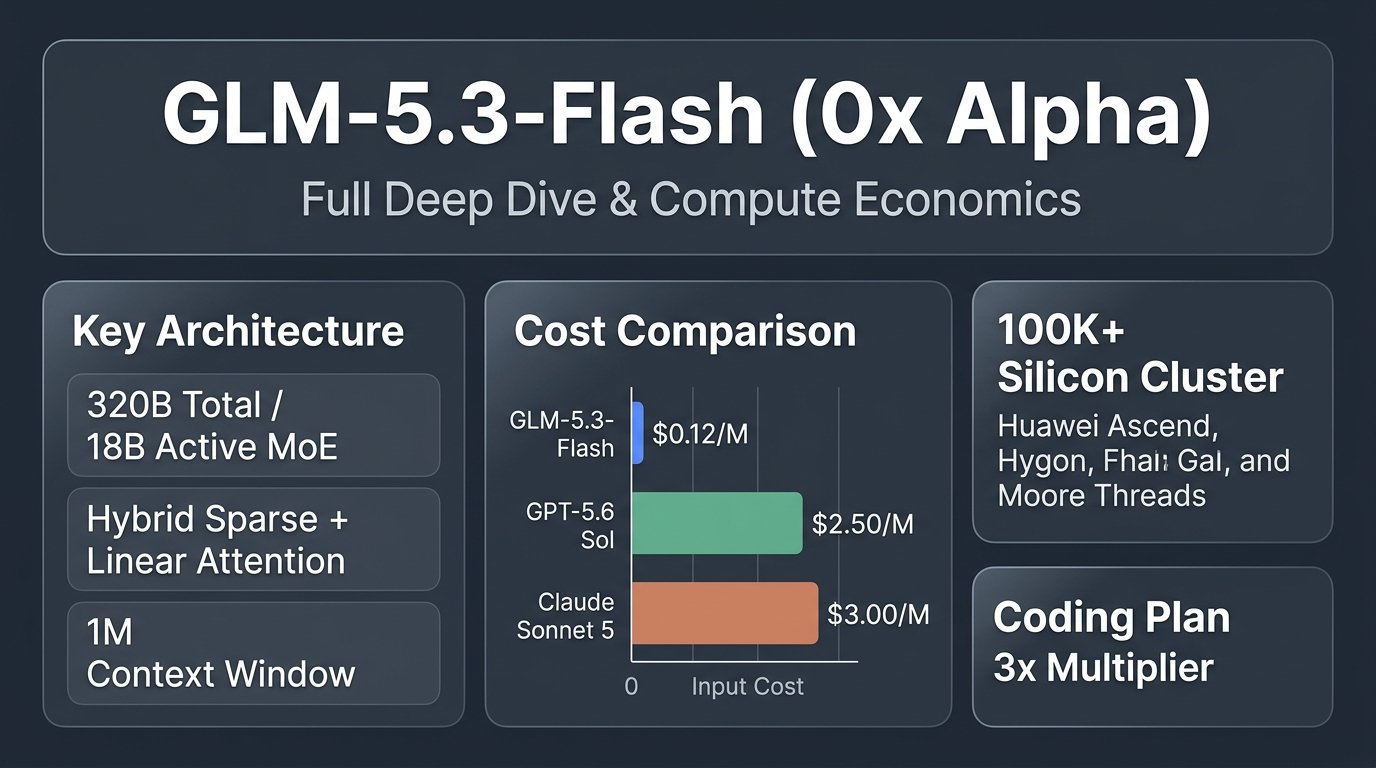
ox-alpha(0x), which topped OpenRouter traffic with blazing response speeds and solid coding benchmarks, is confirmed to be Zhipu GLM-5.3-Flash. - Architectural Breakthrough: 320B total parameters / 18B active parameters MoE architecture featuring an industry-first hybrid sparse and linear attention mechanism combined with manifold-constrained Hyper-Connections (mHC), achieving an ultra-compact KV Cache and native 1,000,000-token (1M) context window.
- Extreme Cost Efficiency: Official API pricing is $0.12 / M input tokens, $0.42 / M output tokens, and $0.034 / M cached tokens. Total invocation cost is just 1/25 to 1/40 of Claude 5 flagship models and 1/20 of GPT-5.6 flagship, posing fierce competition to DeepSeek.
- Coding Plan 3x Multiplier: Under Zhipu's official GLM Coding Plan subscription, GLM-5.3-Flash receives a 3x quota multiplier compared to standard flagship rates, designed specifically for long-horizon autonomous Agent workloads.
- Milestone Domestic Infrastructure: Both the blind-test and production traffic run entirely on a domestic 100,000+ chip cluster (including Huawei Ascend, Hygon, Moore Threads, etc.), validating high-throughput frontier inference free from overseas GPU dependency.
- Objective Pitfall Workarounds: Direct engineering solutions and anti-loop directives for occasional infinite loops and blank output edge cases.
1. Mystery Leaderboard Champion: Real Power Behind "Ox Alpha"
Over the past few weeks, developer communities across OpenRouter and OpenCode were captivated by the anonymous model stealth/ox-alpha. In blind benchmarks, it showcased stellar long-context retrieval, multi-file code editing, and multi-turn Agent orchestration, breaking platform traffic growth records.
On August 26, 2026, Zhipu AI officially open-sourced and launched GLM-5.3-Flash, pulling back the curtain.
1. Why "Lightweight Activation" Delivers Flagship Coding Performance
GLM-5.3-Flash uses a 320B MoE design with only 18B activated per token. Expert routing tuned specifically for code generation and agent planning—paired with hybrid sparse and linear attention—drastically reduces memory bandwidth and KV Cache overhead at long context lengths.
When loaded with large codebases spanning tens of thousands of lines in Claude Code, Cline, Roo Code, or Aider, GLM-5.3-Flash delivers rapid Time-To-First-Token (TTFT) and high throughput, matching top-tier models on LiveCodeBench and SWE-bench Verified.
2. Native Multimodality for UI and Full-Stack Engineering
As the first natively multimodal model in the GLM-5 lineup, GLM-5.3-Flash natively ingests images and video frames. For frontend refactoring and UI troubleshooting, developers can feed design mocks, DevTools error screenshots, or runtime recordings directly to the Agent. The model performs pixel-level visual diffing to fix CSS/DOM bugs, enabling true "see-and-fix" workflows.
2. Objective Analysis: Where Do "Infinite Loops" and "Blank Outputs" Come From?
Under heavy real-world stress testing, while GLM-5.3-Flash performs impressively, developers have encountered edge-case issues: primarily occasional infinite tool loops and occasional blank outputs/truncations.
Understanding their underlying root causes is key to harnessing the model reliably:
1. Occasional Infinite Loops (Tool Call Loops & Repetitive Reasoning)
- Symptom: Common in autonomous coding agents (Cline, Claude Code, OpenClaw) during self-correction. When a test fails or visual feedback falls short, the model may repeatedly execute the same
greportestcommand without altering code. - Root Causes:
- Visual Feedback Sensitivity: Subtle rendering variations in visual diffs can cause reasoning confidence to oscillate;
- Attention Saliency on Past Failures: In ultra-long contexts (>200k tokens) filled with repetitive error logs, attention weights can fixate on previous failed steps, leading the model to repeat identical actions;
- Client Prompt Incompatibilities: Some IDE extension prompts designed specifically for Claude models create subtle schema ambiguities during GLM tool-call translation.
2. Occasional Blank Outputs (Silent Failures & Premature Stops)
- Symptom: The client waits for a response only to receive empty text, or the stream abruptly cuts off after a few tokens.
- Root Causes:
- High Concurrency Connection Jitter: Post-launch traffic spikes occasionally cause gateway streaming timeouts;
- Single-Step Token Truncation: When the model attempts to emit a massive code diff exceeding single-step generation limits, the stream is abruptly cut off;
- Strict Tool-Call Schema Interception: Minor non-standard escaping in model JSON outputs can be dropped by intermediate adapters without propagating clear error traces.
🛠️ 3 Proven Engineering Workarounds
To eliminate these issues in daily development, configure your Agent clients (Cline, Claude Code, Roo Code, OpenCode) with the following best practices:
- Inject an "Anti-Loop" System Prompt Directive: Add a strict constraint in Custom Instructions:
*"If you execute the same command or tool twice with identical parameters and it produces no incremental progress, DO NOT try a third time. STOP immediately, summarize what failed, and ask the user for guidance."*
- Configure Step Limits & Token Budgets: Set single-turn
max_tokensbetween 4096 and 8192, and cap autonomous task iterations at Max Iterations ≤ 25. - Enable Exponential Backoff Retries: In API/SDK wrappers, catch empty or truncated responses (
null/ empty string) and trigger an automatic retry (typically succeeding on the 2nd attempt).
3. Price-to-Performance Breakdown: Comparison vs GPT-5.6, Claude 5, and DeepSeek
Among the 2026 frontier model tier, GLM-5.3-Flash's strongest weapon is its disruptive pricing strategy. With the free preview concluded, standard production rates are set as follows (priced per million tokens):
| Model | Tier / Role | Input Price ($/M) | Output Price ($/M) | Cache Hit ($/M) | Relative Cost Multiplier |
|---|---|---|---|---|---|
| Zhipu GLM-5.3-Flash | Lightweight Flagship / Agent | $0.12 | $0.42 | $0.034 | Baseline (1.0x) |
| DeepSeek-V4 Flash | Budget Standard | $0.15 | $0.30 | $0.015 | ~0.9x ~ 1.1x |
| Zhipu GLM-5.3 | Full Flagship | $2.99 | $7.46 | $0.75 | ~18x ~ 25x |
| GPT-5.6 Luna | OpenAI Lightweight | $0.20 | $0.80 | $0.05 | ~1.7x ~ 1.9x |
| GPT-5.6 Sol | OpenAI Primary Flagship | $2.50 | $10.00 | $0.625 | ~21x ~ 24x |
| Claude Sonnet 5 | Coding Agent Benchmark | $3.00 | $15.00 | $0.30 | ~25x ~ 36x |
| Claude Opus 5 | Frontier Reasoning | $15.00 | $75.00 | $1.50 | ~125x ~ 180x |
📊 Real-World Project Refactoring Cost Simulation
Consider a typical complex full-stack refactoring session:
- Scope: 10 codebase scanning iterations, 5,000,000 total input tokens (80% Prompt Cache hit rate), and 200,000 generated output tokens.
Cost Breakdown per Single Refactoring Session:
• Zhipu GLM-5.3-Flash : $0.12×1 + $0.034×4 + $0.42×0.2   = $0.34
• DeepSeek-V4 Flash   : $0.15×1 + $0.015×4 + $0.30×0.2   = $0.27
• GPT-5.6 Sol         : $2.50×1 + $0.625×4 + $10.00×0.2  = $7.00
• Claude Sonnet 5     : $3.00×1 + $0.30×4  + $15.00×0.2  = $7.20
• Claude Opus 5 : $15.00×1 + $1.50×4 + $75.00×0.2 = $36.00Takeaway: For heavy autonomous Agent loops, GLM-5.3-Flash cuts monthly AI coding bills from hundreds of dollars down to a few dollars while maintaining top-tier code completion and reasoning capability.
4. GLM Coding Plan Breakdown: How Much Code Can You Ship?
For developers preferring a monthly subscription over per-token billing, Zhipu offers the GLM Coding Plan.
1. Subscription Tiers and Credit Allowances
The plan uses a weekly credit refresh mechanism across three tiers (with 20% discount on quarterly and 30% on annual billing):
| Plan Tier | Monthly Price | Weekly Credit Quota | 5-Hour Dynamic Ceiling | Target User |
|---|---|---|---|---|
| Lite | $17.60 / month | 10,000 Credits | Moderate | Solo developers, indie hackers, light daily coding |
| Pro | $80.30 / month | 60,000 Credits | Generous | Full-time software engineers, daily heavy Agent use |
| Max | $160.90 / month | 140,000 Credits | Very High | Tech leads, automated refactoring pipelines, teams |
2. GLM-5.3-Flash's "3x Quota Multiplier"
Within the Coding Plan's credit accounting, calling GLM-5.3-Flash consumes credits at 1/3 the rate of flagship GLM-5.3, effectively tripling available usage.
Taking the Lite Tier ($17.60/month) as an example:
- A 10,000 weekly credit quota dedicated to GLM-5.3-Flash supports approximately 600 to 900 multi-turn Agent code modifications, or refactoring 50 to 80 small-to-medium feature modules;
- Paired with the 1M context window, it comfortably handles full-stack project lifecycles from architecture breakdown to unit test verification.
🎁 Official Portal & Exclusive Invite
👉 Sign up for BigModel & Activate GLM Coding Plan (Exclusive Invite)
5. 100,000+ Domestic Chip Cluster: Frontier Silicon Milestone
Beyond benchmarks and pricing, GLM-5.3-Flash marks a strategic milestone: it is the first frontier MoE model to serve worldwide production and blind-test traffic entirely on a 100,000+ domestic AI chip cluster.
1. Why Full-Stack Domestic Compute Matters
Amid ongoing global high-performance GPU export restrictions, GLM-5.3-Flash demonstrates that:
- Deep optimization across Huawei Ascend (CANN), Hygon, and domestic silicon provides full hardware acceleration for MoE expert parallelism and hybrid attention kernels;
- With architectural optimizations that reduce KV Cache footprint and memory bandwidth pressure, domestic hardware clusters can deliver sub-second latency, high concurrency, and rock-bottom costs at scale.
2. Open-Source Ecosystem & On-Premises Readiness
GLM-5.3-Flash is released under the MIT License, providing open weights alongside official support for vLLM, SGLang, llama.cpp, and domestic inference stacks, enabling friction-free enterprise private deployments.
🎯 Summary & Daily Driver Recommendation
The official reveal of GLM-5.3-Flash (formerly Ox Alpha) ends days of developer speculation while establishing a new 2026 price-to-performance benchmark through 320B-A18B MoE innovation, 1M context length, native visual debugging, and disruptive pricing.
Although the free preview has concluded, its fractional token cost and 3x Coding Plan multiplier make it an exceptional daily driver for developers running agentic code generation in 2026.
👉 Visit BigModel Open Platform (Exclusive Referral Link)
📬 Subscribe to Free AI API Newsletter
Stay tuned for breaking updates, benchmarks, and hands-on integration guides on free and ultra-low-cost frontier AI models!
Community Feedback
Comments are tied to your GitHub account — sign in to join the discussion.